.svg)
January 22, 2026
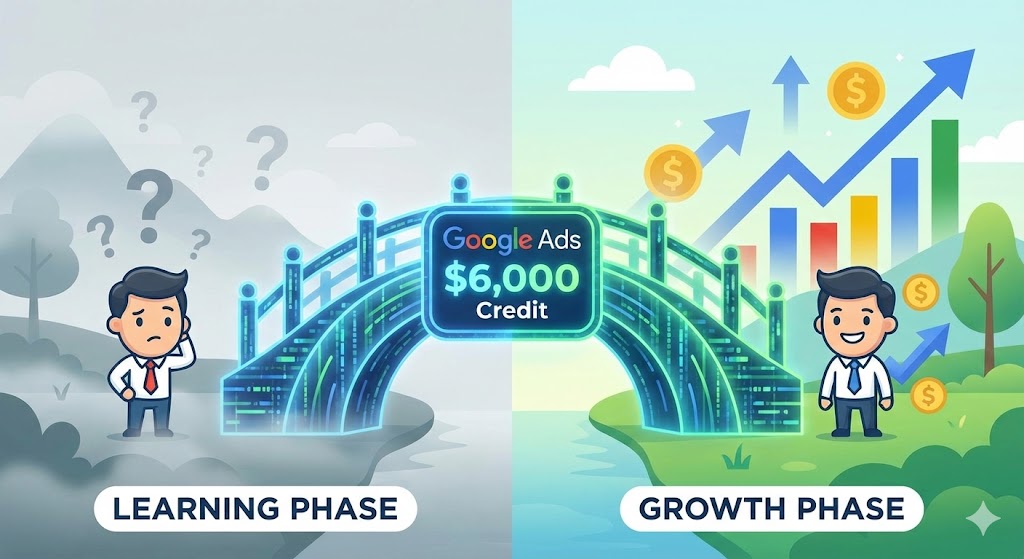
Most business owners hesitate to launch Google Ads because of the dreaded "Learning Phase." This is the 14–30 day window where Google’s AI experiments with your budget to find out who your real customers are. It can be expensive, and honestly, it feels like you're paying for Google’s education.
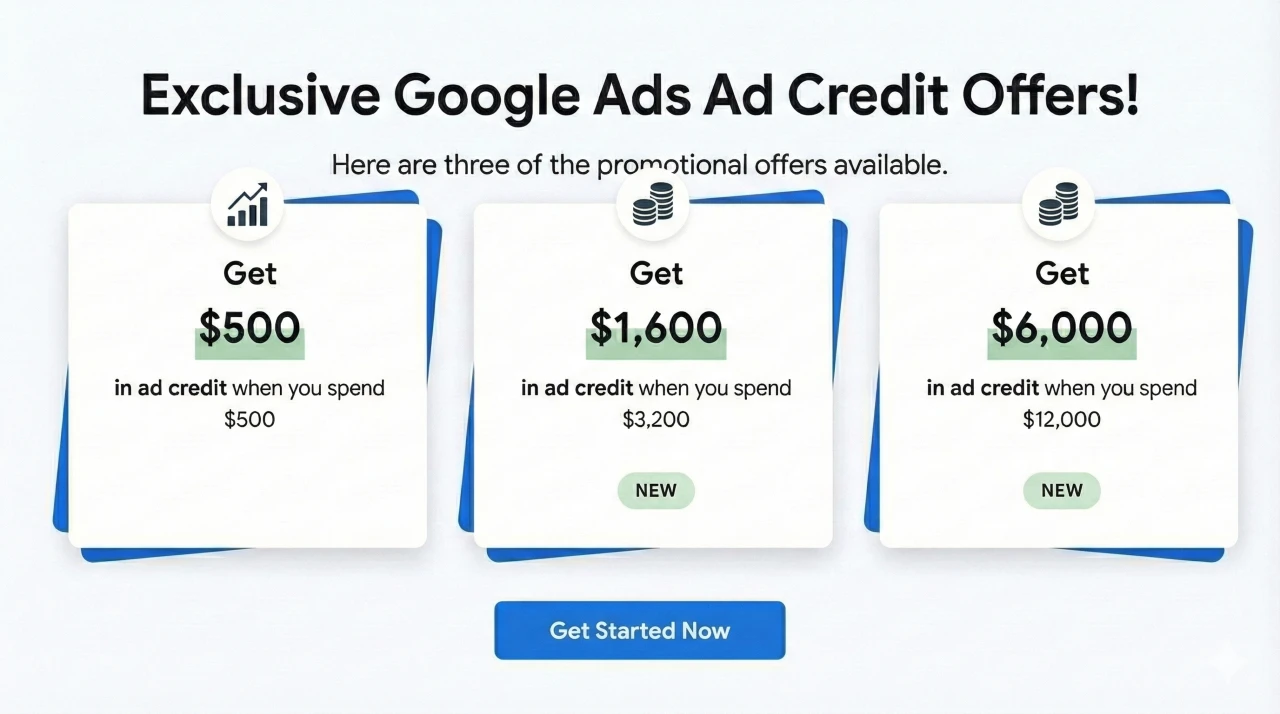
Here's a "loophole" that can help:: Use Google’s exclusive promotional credits to subsidize that data-gathering phase. By leveraging a $1,600 or $6,000 Google Ads credit, you aren't just buying ads; you’re letting Google foot the bill for the trial and error. This allows you to reach the "Optimization Phase"—where the real profit happens—without draining your initial capital.
What We Will Cover
- How Google Ads Credits Work
- Who Qualifies for a Google Ads Credit?
- How to Utilize the Google Ads Credit Wisely
- Final Thoughts
How Google Ads Credits Work
Google doesn't just hand over the promotional credit; there is a strategic "match" system you need to follow to unlock the full power of these offers:
- The Spend-to-Get Model: You must spend a specific amount before the credit is applied. For example, to unlock the massive $6,000 credit, you typically need to spend $12,000 within the first 60 days.
- The 60-Day Sprint: You usually have a 60-day window from the time you apply the promo code to reach your spend goal.
- The Application Delay: Once you hit the required spend, the credit doesn't appear instantly. It typically takes up to 35 days to show up in your billing summary.
- Expiration Date: Once that "free" money hits your account, use it or lose it! Most credits expire within 60 days of being issued.
As a Google Partner, I have access to these promotional credits. If you're looking to start with Google Ads, reach out, mention the credit you'd like to apply, and I'll develop a strategy to ensure we use it efficiently.
Who Qualifies for a Google Ads Credit?
Google's promotional credit tiers are designed to bring in new advertisers:
- New Advertisers: These are generally for accounts that are brand new and are in the process of onboarding with a Google Partner to manage their Google Ads.
- One Per Customer: Google has given us Google Partners a strict guideline—we are only able to apply one promotional credit per customer/business.
How to Utilize the Google Ads Credit Wisely
Don't just set your campaigns and forget them to meet the spending requirement; that's the quickest route to wasting your Google Ads promotional credit. I highly recommend hiring a Google Partner and PPC expert, like me, to ensure your "Learning Phase" leads to a "Profit Phase" by effectively utilizing the free credit.
Key Strategies for Smart Google Credit Use:
- Building Budget Guardrails: Ensuring the AI doesn't spend your entire credit in the first week on low-intent keywords. This involves setting smart spending limits and focusing on high-potential keywords from the start.
- Conversion Tracking Mastery: If you don't track sales correctly, Google's AI learns the wrong lessons, and your credit will be spent finding more "window shoppers" instead of buyers. Accurate tracking is essential to optimize your campaigns for real conversions.
Final Thoughts
By leveraging the $500, $1,600 or $6,000 promotional credits, you aren't just getting free clicks—you’re funding the critical intelligence gathering that your business needs to scale.
The "Learning Phase" is an unavoidable reality of modern AI-driven advertising. Using these credits to subsidize that phase means you enter the market with a massive head start, allowing you to refine your targeting and messaging without the typical "new advertiser" financial stress.
Ready to Triple Your Ad Power? Let’s Get Started
Don't let these high-value credits go to waste on a "guesswork" campaign. Unlocking the $6,000 credit requires a precision-engineered strategy to ensure your initial $12,000 spend generates real leads while simultaneously training Google’s AI to find your best customers.
Schedule a Strategy Consultation Today. In our call, we will:
- Verify Your Eligibility: Ensure your account qualifies for the maximum possible credit (up to $6,000).
- Map Your 60-Day Sprint: Build a tactical plan to hit your spend requirements while maximizing immediate ROI.
- Audit Your Tracking: Make sure every "free" dollar is tracked so we know exactly which keywords are driving your growth.
FAQs
Frequently Asked Questions related to Local SEO
What is Local SEO?
Local SEO (Local Search Engine Optimization) is a specialized marketing strategy focused on making a business more visible in local search results on Google and other search engines.The primary goal is to connect businesses with potential customers who are searching for their specific products or services in a particular geographic area. For example, when someone searches for "pizza near me," "plumber in [City]," or "best coffee shop [Neighborhood]," Local SEO is what helps a relevant local business appear at the top of those results.
Why is Local SEO important?
Simply put, Local SEO is important because it is the single most effective way to connect with customers who are in your area and actively looking to buy what you sell.
Your potential customers are on their phones searching for an immediate solution. Local SEO ensures you are that solution. Here are the key reasons why it is important for local business.
1. It Reaches Customers with High Purchase Intent: Local searches are fundamentally different from broad searches. A person searching for "pizza near me" or "emergency plumber in [Your City]" isn't just doing research—they have an immediate need and are ready to make a purchase.
Fact: 88% of people who conduct a local search visit a related business within 24 hours.
Local SEO puts your business directly in front of these high-intent customers at the exact moment they are ready to buy.
2. Drives Foot Traffic: For brick-and-mortar businesses (like restaurants, retail shops, or clinics), the primary goal is getting people to walk through the door. Local SEO is the digital engine for this.
When you appear in the "Local Pack" (the map and three listings at the top of Google), it dramatically increases your visibility and provides customers with instant directions to your location.
Fact: 72% of consumers who perform a local search end up visiting a store within five miles.
3. It Builds Trust and Credibility: Having a complete, professional, and active online presence makes your business look legitimate and trustworthy.
Reviews: A strong collection of recent, positive reviews is one of the most powerful trust signals. 98% of people read online reviews for local businesses.
Accuracy: A complete Google Business Profile with a correct address, phone number, and hours tells customers you are professional and open for business.
If a customer searches for you and finds an incomplete profile, no reviews, or the wrong hours, they will instantly lose trust and go to your competitor.
4. It's a Highly Cost-Effective Marketing Strategy: Local SEO delivers one of the highest returns on investment (ROI) in marketing.
It's "Free" Traffic: Unlike paid ads (Pay-Per-Click), you don't have to pay for every click you get from the local map pack or organic results. Once you achieve a high ranking, every customer it brings in is essentially free.
5. It Gives You a Competitive Advantage: Even if you are a small local shop, Local SEO allows you to compete with (and often beat) large, national chains in your specific area. This is because Google's local algorithm is designed to favor the most relevant, prominent, and proximate result, not just the biggest brand.
What are Local SEO services?
Local SEO services are specialized digital marketing strategies designed to make a business more visible in geographically-specific searches, like "plumber near me" or "restaurant in [City]." These services typically involve optimizing your Google Business Profile, managing customer reviews, and building local "citations" (mentions of your business name and address online). The ultimate goal is to connect your business with high-intent customers in your immediate area to drive more foot traffic and qualified leads.
What is the difference between SEO and Local SEO?
Traditional SEO focuses on making your website visible to a broad, national, or even global audience, aiming to rank for general keywords (like "how to bake bread").
Local SEO specifically targets customers in your immediate geographic area, aiming to rank for location-based searches (like "bakery near me") and drive foot traffic, primarily by optimizing your Google Business Profile for the "Local Pack" map results.
How to improve Local SEO rankings?
Optimize Your Google Business Profile (GBP): This is the most important step. Completely fill out every section of your profile, including your services, photos, hours, and business description, and use the "Posts" feature regularly.
Build Local Citations: Ensure your business's Name, Address, and Phone number (NAP) are consistent and accurate across all online directories (like Yelp, Apple Maps, and local chamber of commerce sites).
Manage Your Reviews: Actively encourage happy customers to leave reviews and make sure you respond professionally to all feedback—both positive and negative—to show engagement and build trust.
Create Localized Content: On your website, create pages or blog posts that are specific to your service area, mentioning local neighborhoods, landmarks, or news to signal your relevance to Google.
FAQs
Choosing the Right PPC Partner
Does a freelancer have access to the same AI technology as a big agency?
Absolutely. In 2026, the playing field is level. High-level freelancers use the same enterprise-grade predictive bidding and keyword AI tools that agencies do. The difference is that a freelancer manually oversees the AI to ensure it aligns with your specific local market, whereas agencies often use "set-it-and-forget-it" templates.
Will I be locked into a long-term contract?
This is a major difference between the two. Most agencies require 6-month to 1-year contracts to cover their high overhead. Freelancers typically offer much more flexibility, often working on a month-to-month basis. This puts the pressure on the freelancer to deliver results every single month to keep your business.
How do I know my $1,000–$5,000 budget is actually being spent on ads?
Transparency is key. A reputable freelancer will set up your ad accounts (Google, Meta, etc.) in your name, so you have 24/7 access to see exactly where every cent goes. Some agencies "bundle" fees and ad spend together, making it hard to see what you’re actually paying for. Always insist on owning your own data!
What happens if I need to change my strategy quickly?
This is where the freelancer model shines. Because you have a direct line to the person managing the account, pivots can happen within the same day. With an agency, a request often has to go through an account manager, then a strategist, and finally a junior tech, which can take 2-3 days.
Is my business "too small" for professional PPC management?
If you have a monthly budget of at least $1,000 (including ad spend), professional management can actually save you money by narrowing down your targeting. It’s about spending smarter, not just spending more.
FAQs
Frequently Asked Questions about Google Ads Credits
Who is considered a new advertiser for these offers?
To qualify for high-tier credits, your first ad impression must have served from your account no more than 14 days before you enter the promotional code. If you have been running ads for months, you won’t qualify for these specific "new account" offers, though Google occasionally offers smaller "re-engagement" credits to existing customers.
Why has my credit not appeared yet? I’ve already started spending.
There are two main reasons for a delay:
The Spend Threshold: The credit is only triggered once you reach the required spend amount (e.g., spending the full $12,000 for the $6,000 credit).
The Processing Window: Once you hit that threshold, it typically takes up to 35 days for Google to verify the spend and apply the credit to your Billing Summary.
Do these credits expire if I do not use them quickly?
Yes. Once the credit is applied to your account, you usually have 60 days to use it before it expires. This is why having a high-volume strategy ready to go is essential—you don't want "free money" to vanish because your daily budget was set too low.
Can I get a refund for the credit if I cancel my account?
No. Promotional credits are non-refundable and have no cash value. If you cancel your account with a remaining credit balance, that balance is forfeited and cannot be transferred or cashed out.
Will Google notify me when the credit is officially used up?
Typically, no. Google does not send a notification when your promotional credit is exhausted. Your ads will continue to run, and any additional costs will be charged to your primary payment method immediately.
FAQs
Frequently Asked Questions
What is Generative Search?
Generative search represents an evolution of internet search engines, leveraging generative artificial intelligence (AI) to synthesize information from various sources into a concise, direct answer.
Unlike traditional search engines, which primarily provide a list of links requiring the user to visit multiple websites, generative search understands complex, conversational queries. It uses Large Language Models (LLMs) to read, analyze, and summarize content in real-time, providing a comprehensive "snapshot" or overview at the top of the results page.
How does Generative Search work?
Intent Understanding: The AI analyzes the nuance and context of a long-tail query (e.g., "What are the pros and cons of planting succulents in a humid climate?").
Retrieval: It identifies the most relevant, high-quality sources across the web.
Synthesis: The model generates a unique paragraph answering the specific question, citing the sources used.
What is the difference between traditional and Generative Search?
The primary difference is how they process and deliver information. Traditional search relies on information retrieval, indexing web pages to provide a ranked list of links for the user to explore. Generative search relies on content synthesis, using Large Language Models (LLMs) to understand the intent behind a query and generate a single, direct answer derived from multiple sources.
While traditional search acts as a librarian pointing you to the right book, generative search acts as a research assistant that reads the books for you and summarizes the answer.
How does Generative Search impact SEO?
Generative search fundamentally shifts SEO from focusing on ranking links to optimizing for answers. While it may reduce the volume of "top-of-funnel" clicks for simple questions (zero-click searches), it often increases the quality of traffic by sending users who are further down the decision-making funnel.
The Three Main Impacts on SEO:
1. Shift to "Zero-Click" Environment: For simple informational queries (e.g., "What is the capital of France?"), users will likely get their answer directly from the AI Overview without clicking a link. This means a potential drop in overall traffic volume for broad, general definitions.
2. Rise of "High-Intent" Traffic: Users who do click through from a generative answer are typically looking for deep verification, expert opinion, or a specific transaction. This traffic often has a higher conversion rate because the user has already been "pre-educated" by the AI summary.
3. From Keywords to Context: Traditional SEO prioritizes specific keywords. Generative search prioritizes Topical Authority and Context. To rank, content must demonstrate E-E-A-T (Experience, Expertise, Authoritativeness, and Trustworthiness) so the AI trusts it enough to cite it as a source.
How can I optimize my content for AI Overviews?
To optimize for AI Overviews, you must shift from "writing for keywords" to "writing for answers." This strategy, known as Generative Engine Optimization (GEO), focuses on structuring your content so AI models can easily read, understand, and cite it as a trusted source.
The AI Optimization Checklist:
1. Adopt the "BLUF" Method (Bottom Line Up Front): Start every major section with a direct, 30-50 word summary of the answer. AI models often pull this specific paragraph to form the "snapshot" answer at the top of search results.
2. Use Question-Based Headings: Format your headers (H2s and H3s) as full questions (e.g., use "What are the benefits of GEO?" instead of just "Benefits"). This helps the AI map your content directly to user queries.
3. Structure Data for Scannability: Avoid walls of text. Use bullet points, numbered lists, and comparison tables wherever possible. AI models assign higher utility scores to content that is visually organized and easy to extract.
4. Demonstrate E-E-A-T (Experience, Expertise, Authority, Trust): AI models prioritize "high-confidence" sources. Include author bios, cite primary data, and use citations from other reputable sites to prove your content is factually accurate.
5. Implement Schema Markup: Use technical code like FAQPage or Article schema. This acts as a "digital name tag" that tells the AI exactly what your content is and how to categorize it.
Pro Tip: Do not "stuff" keywords. Generative AI uses semantic matching, meaning it looks for the meaning and context of your content, not just specific words. Write naturally and conversationally.
FAQs
Frequently Asked Questions
What is Search Engine Positioning?
Search Engine Positioning (SEP) refers to the process of optimizing specific web pages on a website to achieve higher, more visible rankings in the Search Engine Results Pages (SERPs).
What is Search Intent?
Search Intent (also known as User Intent or Keyword Intent) is the purpose or goal a person has when typing a query into a search engine like Google.
It's the "why" behind the search. Instead of just focusing on the words themselves, search engines work hard to understand what the user wants to accomplish by submitting that specific query.
How do I determine the Search Intent for a keyword?
The simplest way to determine intent is a two-step analysis:
1. Analyze the SERP (Search Engine Results Page): Google the keyword. What kind of pages rank on the first page?
Informational (Guides, blog posts, definitions)
Transactional (Product pages, category pages with "Buy" buttons)
Commercial (Review lists, comparisons with "Best" in the title)
Navigational (A specific company's homepage)
2. Analyze the Modifiers: Look at the surrounding words used with the keyword. Words like "how," "best," "vs," or "buy" are strong indicators of the user's underlying goal.
If the top-ranking pages are articles, your page should be an article. If they are product pages, your page should be a product page.
How does website speed affect my Search position?
Speed is a critical ranking factor (part of Core Web Vitals). Pages that load slowly frustrate users, leading to a high Bounce Rate (users quickly leaving), which signals low quality to Google and negatively impacts positioning.
What is E-E-A-T, and why is it important for ranking?
E-E-A-T stands for Experience, Expertise, Authoritativeness, and Trustworthiness. Google uses these concepts to evaluate the quality and credibility of a website. Demonstrating E-E-A-T is key to long-term positioning success.
FAQs
Frequently Asked Questions
What is White-Label Outsourcing in the context of a digital marketing agency?
White-label outsourcing refers to partnering with an external provider (a fulfillment partner) to execute specialized services—like PPC, SEO, or web design—under your agency's brand. The agency focuses on selling the service and managing the client relationship, while the white-label partner handles the fulfillment. This approach is highly valued for its scalability and often lower cost compared to hiring specialized in-house staff for every service.
What are the main benefits of using a white-label partner?
Outsourcing specialized work is a strategic move that helps agencies:
Expand Service Offerings: Agencies can offer services outside their core expertise (e.g., an SEO agency can offer PPC) without having to build a new department from scratch.
Increase Scalability: External partners allow the agency to take on more clients and projects quickly without a significant increase in internal overhead costs.
Leverage Expertise: Agencies gain immediate access to experienced specialists in specific, complex areas, leading to better results for their clients.
What is the biggest risk for an agency when outsourcing client work?
The biggest risk is relinquishing complete control and damaging your professional reputation. Even when you outsource, you are ultimately accountable to your client for the outcome. If an agency doesn't fully grasp the service being sold, it can lead to:
1. Setting unrealistic expectations for the client.
2. Inability to answer client inquiries accurately.
3. Subpar client experience.
How can an agency ensure quality control and client satisfaction when outsourcing?
1. Maintain Engagement: Do not hand off the project and walk away; stay informed on progress and results.
2. Understand the Service: Cultivate a genuine curiosity about how the service functions to set realistic expectations and answer client questions.
3. Require Training & Support: Choose a reputable partner that provides ongoing support, training, and valuable insights to help you maintain oversight and internal knowledge.
How do I choose the right white-label fulfillment partner?
Select a partner that offers more than just execution. The ideal partner should be viewed as an extension of your own team and offer:
1. Training and Support: They should be willing to educate you so you can confidently address client questions.
2. Transparency and Insights: They should provide clear reporting and valuable insights into the work being done.
3. Long-Term Commitment: They should have the resources and capacity to grow with your agency and foster long-term success.
FAQs
Frequently Asked Questions
What is Generative Search and how does it differ from traditional Search?
Generative Search (like Perplexity AI) uses Large Language Models (LLMs) to synthesize information from multiple sources and generate a single, direct, conversational answer. Traditional search, in contrast, primarily provides a ranked list of links, requiring the user to click through and find the answer themselves.
What is the biggest challenge Generative Search poses to traditional SEO?
The biggest challenge is the shift to a "zero-click" environment for informational queries. Because the AI provides a full answer directly, users are less likely to click through to the original source, potentially leading to a drop in organic traffic volume for publishers.
How do Perplexity Ads differ from Google Ads?
The primary difference lies in the pricing model. Traditional search advertising (like Google Ads) relies on a CPC (Cost Per Click) model. Perplexity is anticipated to adopt a CPM (Cost Per Thousand Impressions) model, which may change the cost dynamics and strategic focus for advertisers.
Why is Perplexity Ads well-suited for targeting informational intent?
Generative search excels at providing answers to "how-to" and research-based questions. Perplexity Ads can be strategically placed within these AI-generated summaries, allowing advertisers (especially affiliate marketers and local service companies) to capture high-funnel users who are actively seeking valuable advice and information.
What is Generative Engine Optimization (GEO)?
Generative Engine Optimization (GEO) is a content strategy focused on optimizing a webpage so that its information can be easily understood and cited by AI models. This involves structuring content with direct answers, using question-based headings, and demonstrating high E-E-A-T (Experience, Expertise, Authoritativeness, and Trustworthiness).
FAQs
Frequently Asked Questions
What is Google Search Generative Experience (SGE)?
SGE is an innovative feature that uses artificial intelligence to generate detailed, conversational, and personalized answers directly on the search results page. It does this by analyzing and synthesizing information gathered from various online sources.
What is Generative Engine Optimization (GEO)?
Generative Engine Optimization (GEO) is a new, specialized approach to content optimization. It moves beyond traditional SEO by focusing specifically on how AI-powered search engines interpret and interact with content, ensuring it is prepared to answer conversational queries effectively.
How should content be structured to succeed with Generative Search?
Content must be structured for easy interpretation by generative search engines. This involves Multi-Format Optimization, meaning content should be adaptable across text, video, and audio, and include clear structural elements like headings, bulleted lists, informative tables, and descriptive alt text for images.
How do you measure success in AI-Search?
Organizations must track metrics specific to generative search engines, including monitoring visibility and presence within the Search Generative Experience (SGE) results. There are tools that can help you do this, one tool that that I like to use is Search Atlas.
What is the key to long-term success with Generative Search?
The key is to create contextually relevant, high-quality content that resonates with both human users (who seek authentic engagement) and AI systems (which rely on algorithmic understanding). Success requires continuous learning and the ability to balance established SEO principles with innovative GEO strategies.
FAQs
Frequently Asked Questions
What are the four types of Search User Intent in Google Ads?
The four primary types of search user intent that dictate Google Ads strategy are:
1. Informational Intent: Users are seeking knowledge or answers (e.g., "how-to guides").
2. Navigational Intent: Users are trying to find a specific website or brand (e.g., "brand name login").
3. Commercial Intent: Users are researching and comparing products or services before a purchase (e.g., "best tools for X").
4. Transactional Intent: Users are ready to make an immediate purchase (e.g., "buy product X now").
How does optimizing for user intent improve my Google Ads quality score?
Optimizing for user intent is one of the most effective ways to improve your Expected Click-Through Rate (CTR), which is a critical component of the Quality Score. By ensuring your ad copy and landing page perfectly align with the user’s motivation, you increase relevance, which Google rewards with a higher Quality Score, resulting in a lower Cost Per Click (CPC) and better ad positioning.
Is there a specific Commercial Intent tool provided by Google Ads?
No, there is no dedicated, automated "Commercial Intent Tool" provided by Google. The core tool for intent classification is the Search Terms Report (STR). This report requires a continuous, strategic manual analysis of user queries to classify them and refine your campaign structure accordingly.
What is the difference between Commercial and Transactional Intent ad groups?
The difference lies in the stage of the buying journey:
1. Commercial Intent targets users in the research and evaluation phase (Goal: Capture leads, highlight comparisons).
2. Transactional Intent targets users who are ready to buy immediately (Goal: Drive immediate conversion, using urgent CTAs and linking directly to checkout pages).
What is the benefit of basing an entire Google Ads campaign on user intent?
The primary benefit is maximizing Return on Investment (ROI) by eliminating wasted ad spend. An intent-focused strategy ensures that your budget is primarily reserved for high-value Commercial and Transactional queries, significantly increasing conversion rates and overall campaign efficiency.
FAQs
Frequently Asked Questions
What is the difference between White Label PPC and traditional outsourcing?
The main difference is brand ownership and client relationship.
White Label PPC: The third-party provider works completely behind the scenes. Your agency maintains its brand identity and is the sole point of contact for the client, allowing you to present the service as your own and strengthen client relationships.
Traditional Outsourcing: The client is often aware that a third party is managing the work, and the outsourcing company may have some direct interaction or visibility.
How does White Label PPC help my agency scale?
White Label PPC provides instant, flexible capacity. You can take on new clients and larger PPC campaigns without the time, expense, and commitment of hiring, training, and managing new full-time in-house PPC specialists, tools, and infrastructure. Your services scale up or down based on client demand.
Will my clients know I am using a third-party partner?
No. A core principle of a White Label service is that the provider remains completely anonymous to the end-client. All communications, reports, and campaign management activities are branded with your agency's logo and identity, creating a unified and professional experience for your client.
How do I maintain control over the campaigns?
While the partner manages the execution, your agency maintains strategic control.
Communication: You serve as the main communication link, directing the partner on strategy, budget, and client goals.
Reporting: Your partner provides detailed, branded reports and insights, which you review to ensure performance aligns with client expectations.
Transparency: A reputable partner provides a transparent view into the campaign data, allowing your agency to make informed strategic decisions.
What should I look for in a quality white label PPC partner?
The blog highlights four critical factors:
1. Proven Track Record: Look for a strong industry reputation and positive client testimonials.
2. Goal Alignment: Ensure their mission and work style match your agency's values.
3. Commitment to Transparency: They must provide clear communication and detailed, open access to performance data.
4. Custom Reporting: They should offer branded reports that seamlessly integrate with your agency's aesthetic and communication style.
FAQs
Frequently Asked Questions
What are the main sources of Google Ads click fraud?
Click fraud generally stems from three primary sources:
1. Bots: Automated software programs designed to click ads rapidly and in high volume.
2. Click Farms: Organized groups of individuals who are paid to manually click on ads repeatedly.
3. Competitors: Unscrupulous businesses intentionally clicking your ads to quickly exhaust your daily budget.
How does click fraud actually hurt my business?
Click fraud harms your business in two main ways:
1. Financial Cost: It directly wastes your advertising budget on clicks that will never lead to a genuine sale or conversion, lowering your Return on Advertising Spend (ROAS).
2. Data Corruption: It contaminates your campaign analytics, making it impossible to accurately judge the performance of your ads and leading to potentially flawed strategic decisions.
Can Google built-in tools prevent click fraud?
Yes, you can strengthen your defenses using tools built directly into the Google Ads platform:
IP and Location Filtering: You can manually exclude specific fraudulent IP addresses and use precise geolocation targeting to only show ads in low-fraud areas.
Alerts and Filters: You can set up alerts for sudden, unexpected click spikes and configure filters to block clicks from known suspicious sources.
IP and Location Filtering: You can manually exclude specific fraudulent IP addresses and use precise geolocation targeting to only show ads in low-fraud areas.
Alerts and Filters: You can set up alerts for sudden, unexpected click spikes and configure filters to block clicks from known suspicious sources.
How can I tell If I am being targeted by click fraud?
While difficult to spot manually, look for suspicious patterns in your data, such as:
1. Unusual and sudden spikes in click activity.
2. Erratic Click-Through Rates (CTR).
3. Numerous clicks originating from the same IP address.
4. High click volume from a source that results in zero conversions.
5. Clicks coming from areas outside your intended target audience.
What is the most effective way to prevent click fraud?
The most effective, modern defense is the integration of real-time automation and AI-powered detection tools (such as Clixtell or ClickCease). These systems continuously analyze massive datasets to identify and block fraudulent patterns that human analysts would typically miss, ensuring your budget is protected around the clock.